Author: Chris Pollard
The views of the Author are not necessarily the views of Enigmose
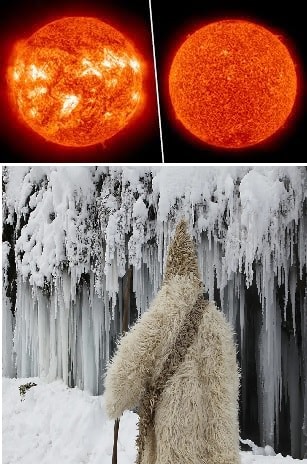
Our sun has gone into lockdown, which could cause freezing weather, earthquakes and famine, scientists say.
The sun is currently in a period of “solar minimum,” meaning activity on its surface has fallen dramatically.
Experts believe we are about to enter the deepest period of sunshine “recession” ever recorded as sunspots have virtually disappeared.
Astronomer Dr. Tony Phillips said: “Solar Minimum is underway and it’s a deep one.”
“Sunspot counts suggest it is one of the deepest of the past century. The sun’s magnetic field has become weak, allowing extra cosmic rays into the solar system.”
“Excess cosmic rays pose a health hazard to astronauts and polar air travelers, affect the electro-chemistry of Earth’s upper atmosphere and may help trigger lightning.”
NASA scientists fear it could be a repeat of the Dalton Minimum, which happened between 1790 and 1830 — leading to periods of brutal cold, crop loss, famine and powerful volcanic eruptions.
Temperatures plummeted by up to 2 degrees Celsius (35.6 degrees Fahrenheit) over 20 years, devastating the world’s food production. Read More
Solar Minimum is Coming
From NASA SCIENCE
High up in the clear blue noontime sky, the sun appears to be much the same day-in, day-out, year after year.
But astronomers have long known that this is not true. The sun does change. Properly-filtered telescopes reveal a fiery disk often speckled with dark sunspots. Sunspots are strongly magnetized, and they crackle with solar flares—magnetic explosions that illuminate Earth with flashes of X-rays and extreme ultraviolet radiation. The sun is a seething mass of activity.
Until it’s not. Every 11 years or so, sunspots fade away, bringing a period of relative calm.
“This is called solar minimum,” says Dean Pesnell of NASA's Goddard Space Flight Center in Greenbelt, MD. “And it’s a regular part of the sunspot cycle.”
The sun is heading toward solar minimum now. Sunspot counts were relatively high in 2014, and now they are sliding toward a low point expected in 2019-2020.
While intense activity such as sunspots and solar flares subside during solar minimum, that doesn’t mean the sun becomes dull. Solar activity simply changes form.
For instance, says Pesnell, “during solar minimum we can see the development of long-lived coronal holes.”
Coronal holes are vast regions in the sun’s atmosphere where the sun’s magnetic field opens up and allows streams of solar particles to escape the sun as the fast solar wind.
Pesnell says “We see these holes throughout the solar cycle, but during solar minimum, they can last for a long time - six months or more.” Streams of solar wind flowing from coronal holes can cause space weather effects near Earth when they hit Earth’s magnetic field. These effects can include temporary disturbances of the Earth’s magnetosphere, called geomagnetic storms, auroras, and disruptions to communications and navigation systems.
During solar minimum, the effects of Earth’s upper atmosphere on satellites in low Earth orbit changes too.
Normally Earth’s upper atmosphere is heated and puffed up by ultraviolet radiation from the sun. Satellites in low Earth orbit experience friction as they skim through the outskirts of our atmosphere. This friction creates drag, causing satellites to lose speed over time and eventually fall back to Earth. Drag is a good thing, for space junk; natural and man-made particles floating in orbit around Earth. Drag helps keep low Earth orbit clear of debris.
But during solar minimum, this natural heating mechanism subsides. Earth’s upper atmosphere cools and, to some degree, can collapse. Without a normal amount of drag, space junk tends to hang around.
There are unique space weather effects that get stronger during solar minimum. For example, the number of galactic cosmic rays that reach Earth’s upper atmosphere increases during solar minimum. Galactic cosmic rays are high energy particles accelerated toward the solar system by distant supernova explosions and other violent events in the galaxy.
Pesnell says that “During solar minimum, the sun’s magnetic field weakens and provides less shielding from these cosmic rays. This can pose an increased threat to astronauts traveling through space.”
Solar minimum brings about many changes to our sun, but less solar activity doesn’t make the sun and our space environment any less interesting.
Ethnobotanist Terence McKenna took Timothy Learys advice back in the 60s to 'turn on, tune in and drop out' and he believes that eons ago some of our ape-like ancestors did just the same thing.
McKenna authored 'Food of the Gods ', an exploration of humanities harmonious history with plants, and their chemical properties. One of his theories was that Homo erectus ingested the same magic mushrooms while on their evolutionary journey, that enabled them to evolve into Modern Homo-Sapiens.
Gurkha flying in his swift and powerful Vimana hurled against the three cities of the Vrishis and Andhakas a single projectile Charged with all the power of the Universe. ...An incandescent column of smoke and flame As bright as the thousand suns Rose in all its splendor..a perpendicular explosion with its billowing smoke clouds... ...the cloud of smoke rising after its first explosion formed into expanding round circles... like the opening of giant parasols... In the early 1900s, archaeologists uncovered the ruins of a this large ancient town of which the ancient Vedas speak. Nuclear ruins from pre-history.

