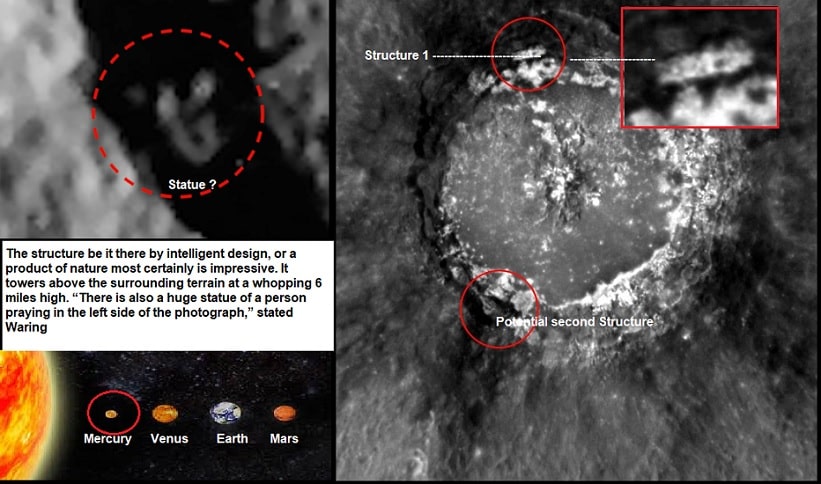
UFO hypster Scott C. Waring believes he has spotted a megalithic structure on Mercury of all places. Mercury, the closest to the Sun and the smallest of the eight planets in our solar system. So far as we know it is basically a death trap for ant unlucky space farer unfortunate enough to find themselves on its barren surface. It has virtually no atmosphere and surface temperatures fluctuate from -280 degrees F at night to over 800 degrees F at its sunny equatorial regions. You freeze dry in the evening and get get refried at sunrise.
The structure be it there by intelligent design, or a product of nature most certainly is impressive. It towers above the surrounding terrain at a whopping 6 miles high. “There is also a huge statue of a person praying in the left side of the photograph,” stated Waring
Waring claims intelligent aliens would be able to construct buildings of these monumental proportions due to the weak gravity on mercury, which is 38% of Earths.
The arrival of BepiColumbo in 2025 could prove or disprove Warings tower theory. In either event new images destined to be returned by the joint European and Japanese Aerospace project,willl certainly open up new mysteries as paredoilic imagery is spun by the hypsters. But then again what if it's not Paredoila ?